

It was so wonderful to be back at the Communication Matters this year after child care problems forced me to miss 2025.
If you’ve never been to CM it’s hard to capture the feel of the conference. The mixture of academic papers, lived experience and clinical practice, reflected in the presentations and workshops but also the participants is incredibly powerful.
One of the things that came across in a lot of the sessions was the focus on meaningful connection and communication as well as a focus on use and implementation of technologies.
In the opening keynote Jeff Higginbotham set the tone with his talk focussed on timing and interaction where he talked about the idea of us falling into a ‘technotrap’. I will confess to being a little distracted in this session as I was anticipating delivering my own session which was next. I did nip out a little early to get myself set up.
You’ll be able to read about my platform presentation in the communication matters journal if you’re a member. In short I talked about some of the ideas that I’ve embraced and abandoned when thinking about what makes for meaningful conversation and interaction with my daughter Lucy and how we now consider AAC within a range of tools.
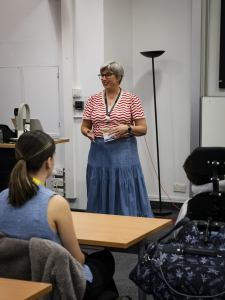
The next session I went to continued on that theme with Euan Robertson and Rachel Langley from Assistiveware discussing a tool they’re developing to better capture progress for Emergent AAC Users. If you’re not familiar with that terminology then it’s worth describing it here briefly. On their goals grid (see link at the bottom of the page) Tobii Dyanavox define emergent communicators as people who ‘may have limited or no understanding that symbols (e.g., photos, line drawings) represent things, places, ideas, etc. and may not yet have a consistent method of communication.’. It’s great to hear people talking in a meaningful way about supporting communication with people with the most complex motor and learning needs.
Other sessions on the first day included the therapy team from AT therapy on coaching parents and an intriguing session about developing a AI tool for language therapy in AAC. The AI session opened up a lot of questions for me and for other people I chatted to about the place of AI tools in therapy. My thoughts are that for kids whose goals can be met by using AI learning tools then we should be using them just like we would be for anyone whose learning would benefit.
Monday night brought the conference dinner and disco with a 1986 theme as CM was celebrating it’s 40th birthday this year. It was a terrific setting in the New Dock Hall at the Royal Armouries in Leeds. I walked with a couple of visitors to the city down from the University to the Armouries and it was lovely to show some of the wonderful buildings and architecture. I’m from very close to Leeds and it’s so easy to take our places for granted. It’s refreshing to see places through other people’s eyes.
The party was of course wonderful with a great set from Lee Ridley AKA Lost Voice Guy and then with DJ Oli on the eye-gaze controlled decks. I danced until the end of the night, even after a couple of attempts to leave, Oli knew how to get us back on the dance floor.
Tuesday morning brought the closing session from Gavin Clifton. Gavin’s session was incredibly moving on the topic of parents. His comment ‘they stood in the gap where the system failed’ was incredibly powerful and resonated so much with my experience and that of all the parents out there doing their very best surrounded by at best disconnected and at worst absent services. At the risk of cliche there was barely a dry eye in the house as Gavin’s powerful storytelling found something that spoke to everyone in the room.
Katie Dooley Cawley’s session about her research with paid care staff working with adults with learning disabilities was so relevant. She talked to staff from many different settings and did not only ask questions about what was happening but also about why. One of the most powerful takeaways for me was that ‘variation does not automatically mean failure’. The observation that AAC is not in use is not always a reflection of some of the things we assume like lack of knowledge, skill or will but rather a reflection of choices built on person-centred practice.
Sarah Dunn’ session about her PhD research into eye-gaze technology, music and singing and a subsequent lunchtime chat with her got me reflecting and learning about dimensions of well being. The final conference session had me chairing an incredibly busy session about mapping and shared planning for AAC and AT services with Tina Voizey and Fil McIntyre.
Some of us stuck around after the last day for the research study day where I teamed up with Dr Sarah Hayward to present some of the work we’ve done together and to talk about co-production in research. This was a really thought provoking day too, I’m sorry not to have been able to attend Jeff Higginbotham’s parallel sessions on the day.





Leave A Comment